Ineffable Management's Reid Foster on smart automation, "fan karma," and why AI will save artist teams time, but never replace sweaty dance floors.
September 23, 2026
Reid Foster sorts AI into two piles. One gives his team hours and dollars back. The other steals from artists.
As SVP at Ineffable Management, he runs strategy for a roster of artists including Stick Figure and The Elovaters. Earlier this year, his team activated an AI agent that recovers 28% of abandoned merch cart sales. He also thinks artists should rebel against AI in their creative output.
We talked with him about first party data, fan karma, merch, and why, even in the age of AI, there's still no substitute for a sweaty dance floor.
You've talked about "fan karma" as a core guiding principle for Ineffable and the artists on your roster. How does that work in practice?
Fan karma is a concept we've embraced as a company for many years, sort of like a balance sheet of the artist-fan relationship. When we give our fans something for free, the meter goes up. When we ask them to open their wallets, give us first-party data, etc, the meter goes down. The difference can be really nuanced and subjective, but we try to keep the idea as a north star with everything we do. Are we spamming people? Hopefully not, but maybe we should think twice before we send that email or text.
If fan karma is the north star, why is owning that connection through first party data so crucial compared to relying on social algorithms?
Social media platforms change every day, so if that's your only way to connect to your audience, you're never gonna reach everyone. Names, emails, phone numbers, etc don't change nearly as often. First party data is really the foundation everything else is built on.
"First party data is really the foundation everything else is built on."
AI is rapidly entering the music industry. Where does it create real leverage for artist teams, and where does it cross the line?
AI creates the most value where it saves us time.
This is a real Pandora's box, so here are a few bullet points…
- A while ago I heard an analogy that AI is like a hammer… you could use it to build a house, or you could use it to kill someone.
- It's the most powerful technological advancement we've seen in generations & there are obvious uses that raise the tide for everyone: research, organization, operational tasks, etc. So if you're not learning to use it in business, you're going to be left behind.
- AI makes it way too easy to steal & profit from other people's hard-earned intellectual property, whether it's a song, a picture, a poem, an essay, anything and everything humans have learned to craft over time. So as artists, we need to rebel against AI in our creative output.
- What AI can't replace is human-to-human connection…eye contact from across a room, sweaty dance floors, thousands of people doing something in unison, the energy of something made by hand.
- I'm not convinced we're ever gonna have some sort of hallelujah moment as a society on how to balance it all.
- We need regulation that protects IP & protects the planet.
"AI is like a hammer. You could use it to build a house, or you could use it to kill someone."
You were an early tester of Laylo's UGC Agent. What happened when you turned it on?
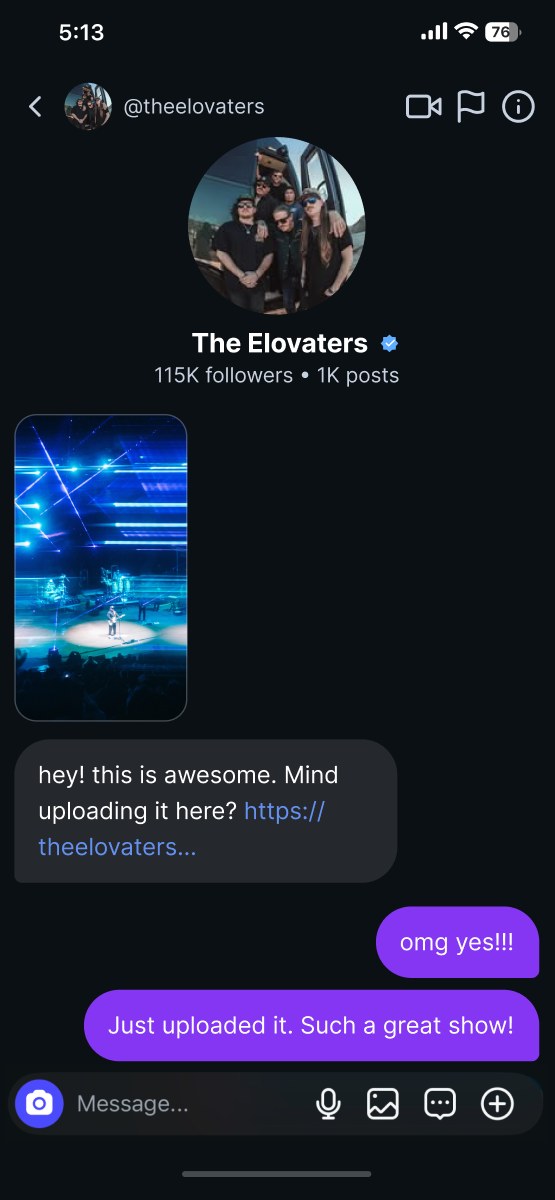
It just started working and delivering us UGC from basically every show while the band was on tour. Next thing we knew we had this pipeline for getting UGC in the door, which revealed itself pretty quickly as a missing link for broader content strategy. Shout out Shelby Rios on our team who figured it out!
"It just started working and delivering us UGC from basically every show while the band was on tour."
The Elovaters do a lot of limited merch drops. How do you keep selling to fans without burning through that fan karma?
We can only go to the well so often, so we need to make it count when we do, meaning we need to provide real value to our fans while also crossing the t's and dotting the i's of data collection.
We think about genuine exclusivity — limited edition things that only so many people will ever have (50, 100, 250 units, etc). This has cultivated a really cool community of collectors who trade with each other, meet up at shows, bring those things to our VIP meet & greets for the band to sign, etc. We also have some fans who make really cool stuff & ask to partner with us — awhile ago we decided to stop looking at that situation through the lens of merch and margins & more about spotlighting cool people doing cool things around us. Family power.
"We think about genuine exclusivity — limited edition things that only so many people will ever have."
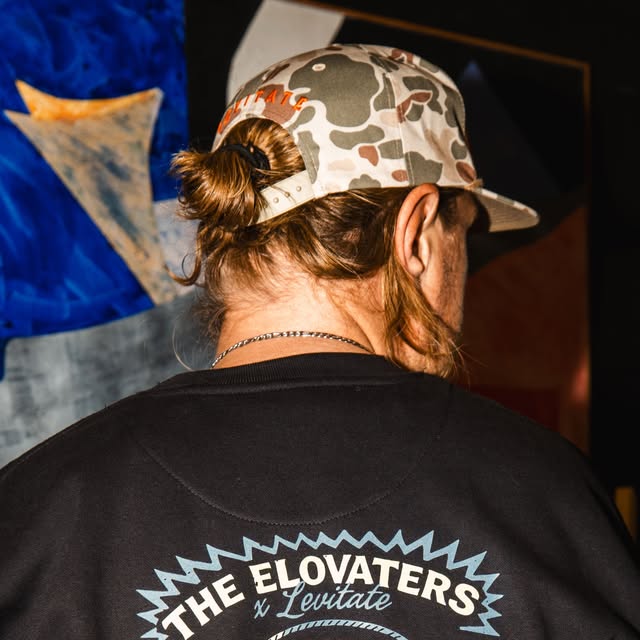
And we try to do fun things at shows when we can…scavenger hunts, or "scan this QR code and we'll pick someone to hang with us after the show." We did a photo booth at a hometown show to soft-announce the new album earlier this year, and we're about to start doing collectable keychains for every headline show. In general, we like exploring creative ideas from everyone on the team. I'm just now remembering the first time we got an SMS number — the drummer had a last-minute idea to fly a plane over Levitate Festival with a banner that said "text the Elovaters at xxx-xxx-xxxx" during the set. It cost like $1100, but it was worth it to usher in a new era of direct connection.
"The drummer had a last-minute idea to fly a plane over Levitate Festival with a banner that said 'text the Elovaters.' It cost like $1100, but it was worth it."
The Abandoned Cart Agent is recovering roughly 28% of abandoned merch carts, 9X abandoned cart averages on generic email workflows. What surprised you most after turning it on?
How easy it was. We literally just checked a box.
What do artist teams need to be good at now if they want to build something that lasts?
Too many things to list. But first party data and how they use it is fundamental - you can't really build long term without it. Staying up with new tools, being aware of the current landscape and temperature of any given moment. Content strategy, honesty, vulnerability, the ability to make decisions, and keep it moving. This is all sort of core stuff for any entrepreneur, I think. Artist teams who thrive need to understand how to steer the ship with all these things in mind. Our job is to build communities around art, and there's no substitute for real human touch.
Want more content like this, delivered straight to your inbox? Subscribe to Laylo's Top Drops.